Currently Empty: R0.00

Hybrid Inverter vs Standard Inverter: Which One Should You Choose?
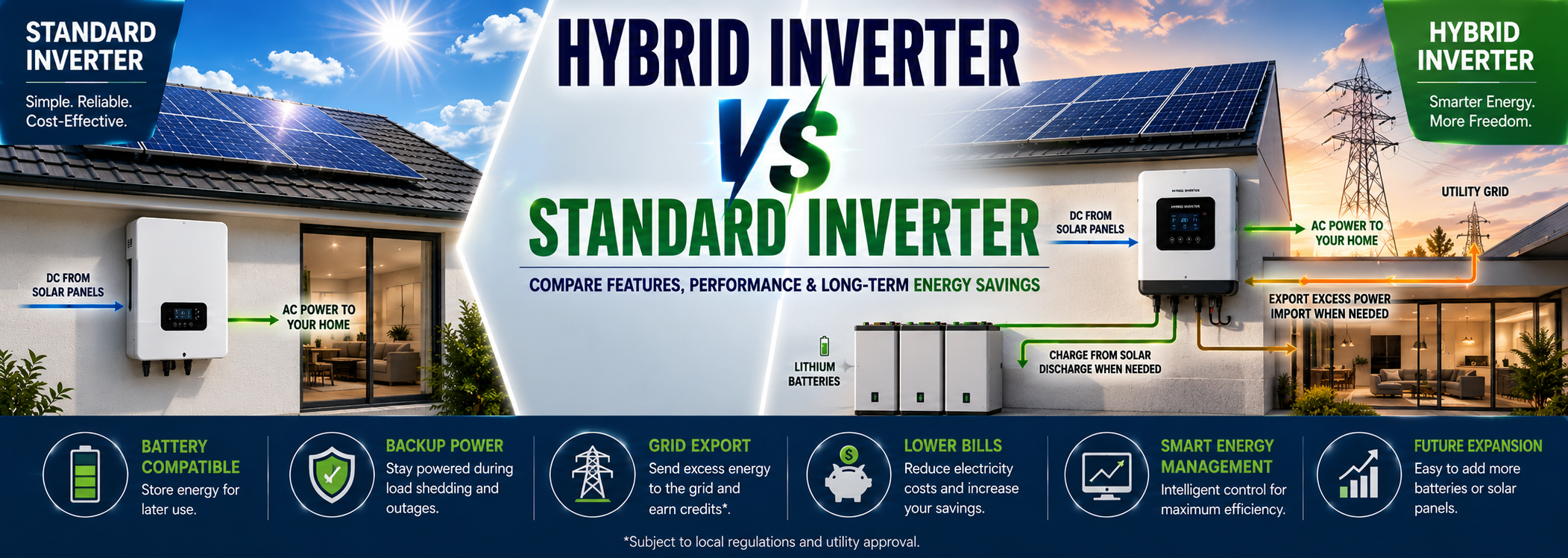
Choosing the right inverter is one of the most important decisions when installing a solar energy system. A hybrid inverter offers more flexibility by working with solar panels, batteries and the electricity grid, while a standard inverter focuses on converting solar energy into usable electricity for immediate consumption.
Understanding the differences will help you select the solution that best matches your energy needs, budget and future plans.
What Is a Standard Inverter?
A standard inverter converts direct current (DC) electricity from solar panels into alternating current (AC) electricity for your home or business.
It performs one primary function exceptionally well—supplying usable electricity while the sun is shining.
If your system generates more electricity than you need, the excess energy cannot be stored unless you install additional equipment designed for battery storage.
Standard inverters are often used in grid-tied solar systems where battery backup is not required.
What Is a Hybrid Inverter?
A hybrid inverter combines several functions into one intelligent device.
Besides converting DC electricity into AC power, it also manages:
- Battery charging
- Battery discharging
- Solar energy production
- Electricity imported from the grid
- Electricity exported to the grid (where permitted)
- Automatic power switching during outages
As a result, hybrid systems provide greater flexibility and energy independence.
How Do They Compare?
| Feature | Hybrid Inverter | Standard Inverter |
|---|---|---|
| Converts DC to AC | ✔ | ✔ |
| Battery compatibility | ✔ Built-in | Usually requires extra equipment |
| Backup power | ✔ | ✘ |
| Grid interaction | ✔ | ✔ |
| Energy storage | ✔ | ✘ |
| Future battery expansion | Easy | More complex |
| Initial cost | Higher | Lower |
Advantages of a Hybrid Inverter
A hybrid inverter offers several important benefits.
These include:
- Supports lithium battery storage
- Provides backup power during outages
- Automatically manages energy flow
- Reduces electricity purchases from the grid
- Allows future battery expansion
- Can export surplus electricity where regulations allow
- Improves overall energy independence
For many homeowners, these features make hybrid systems a worthwhile long-term investment.
Advantages of a Standard Inverter
Although simpler, a standard inverter still offers many advantages.
These include:
- Lower purchase price
- Easier installation
- Proven reliability
- Excellent efficiency
- Lower maintenance costs
- Ideal for properties without battery storage
If your goal is simply to reduce daytime electricity consumption, a standard inverter may provide everything you need.
Which Inverter Saves More Money?
The answer depends on how you use electricity.
A standard inverter can lower your electricity bill during daylight hours by allowing you to use solar power instead of grid electricity.
A hybrid inverter goes further by storing excess solar energy in batteries. You can then use this stored energy at night, during cloudy weather or while experiencing load shedding.
Over time, this can increase your savings and reduce your dependence on the electricity grid.
Which One Is Better for Load Shedding?
If reliable backup power is important, a hybrid inverter is the better option.
Because it works with battery storage, it can continue supplying electricity when the utility grid fails.
A standard inverter without batteries usually shuts down during a power outage, even if the solar panels are producing electricity. This safety feature protects utility workers servicing the grid.
Which Inverter Is Right for You?
A standard inverter is ideal if you:
- Have a limited budget
- Want to reduce daytime electricity costs
- Do not need battery backup
- Have a reliable utility supply
A hybrid inverter is a better choice if you:
- Want backup power during outages
- Plan to install lithium batteries
- Want greater energy independence
- Expect electricity prices to increase
- Want the option to export excess electricity to the grid where permitted
Frequently Asked Questions
Can I add batteries to a standard inverter later?
Yes, but many systems require additional hardware or replacing the inverter. A hybrid inverter usually makes future battery expansion much easier.
Does a hybrid inverter work without batteries?
Yes. It can operate like a standard inverter until batteries are added.
Can both inverters work with solar panels?
Yes. Both convert electricity generated by photovoltaic panels into usable AC electricity.
Is a hybrid inverter worth the extra cost?
For many homeowners and businesses, the additional features, backup capability and future flexibility justify the higher initial investment.
Conclusion
A hybrid inverter offers the greatest flexibility by combining solar generation, battery storage and grid interaction in one intelligent system. Although it costs more than a standard inverter, it provides backup power, improves energy independence and prepares your property for future expansion.
A standard inverter remains an excellent choice for customers who want an affordable, reliable solution for reducing daytime electricity costs. By comparing your budget, energy usage and long-term goals, you can confidently choose the inverter that best meets your needs.